
What drives logistics today - technology or relationships?

We sat down for a coffee with QCS Group CCO Luboš Lukáč to discuss growth, trust, speed, partnerships, and the future of freight forwarding.
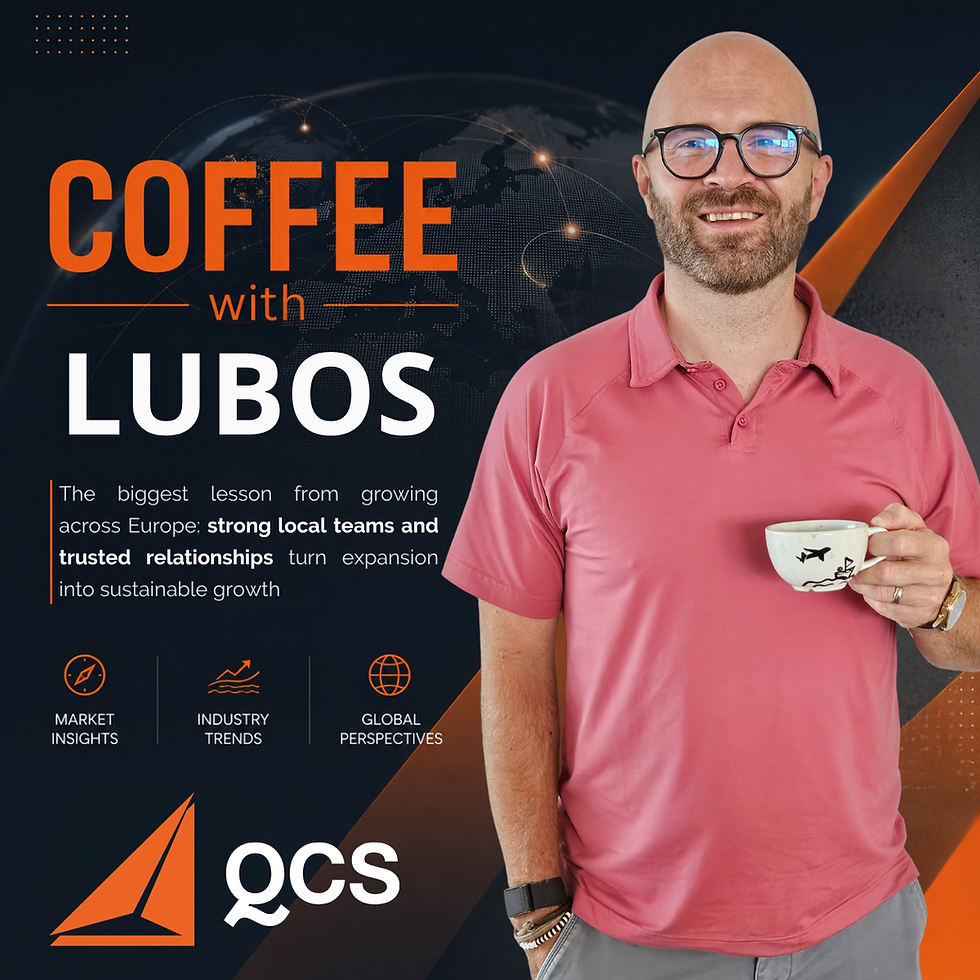
Q: QCS is growing across Europe. What is the biggest lesson you have learned from expansion?
LL: Expansion is not about opening offices. It is about people. You can have a solid plan, the right timing, and the necessary investments, but if you do not have people on the ground who understand the local market and know how to build relationships, it will not work. In practice, we have learned that a strong local team is always the foundation — without it, growth exists only on paper. On the other hand, when you have the right people, growth becomes natural and sustainable.
Q: What do you think has changed the most in logistics over the past few years?
LL: The pace. The expectations of both clients and partners are significantly higher today than they used to be. Everything has to be faster, more precise, and more transparent. Clients expect immediate responses and solutions, not delays. The speed of decision-making has therefore become a key factor — those who react too slowly quickly lose their competitiveness.
Q: Digitalization vs. relationships — what really drives business today?
LL: It is a combination of both. Technology helps you become more efficient, simplifies processes, and gives you better visibility over data. But business itself is still built on people and trust. In logistics, decisions are often made under pressure, and in those moments, trust between partners becomes critical. The best results come when you combine strong relationships with the ability to fully leverage technology.
Q: How does QCS growth fit into this?
A: Expansion goes hand in hand with the strength of the network you build. New markets only make sense if you have quality partners and stable relationships in place. It is not just about entering a market, but about how you operate there in the long term. The combination of strong local teams and a reliable partner network is what allows us to grow consistently.
Q: Recently, we have seen you attending more conferences. Do they still have real value today?
LL: Absolutely — and perhaps even more than a few years ago. A lot of communication has moved online, but that is exactly why personal meetings carry more weight today. When you meet partners face-to-face, you can get to the point much faster and have more open discussions about cooperation. Many things simply cannot be replaced by emails or calls.
Q: What have you taken away from these meetings?
LL: Above all, that the market is moving faster than many people realize. Everyone is dealing with similar challenges — pressure on pricing, speed, and capacity — but the real difference lies in how quickly companies are able to respond. Personal meetings give you a much clearer understanding of who is flexible and who is not.
Q: How do you decide which events to attend?
LL: I try to be selective. It is not about being everywhere, but about being where participation brings real value. What matters is which partners you can meet and whether those meetings lead to concrete results. Time is limited, so quality will always take priority over quantity.
Q: Where are you heading next?
LL: I have attended several conferences recently, and that will continue in the coming months. Next on my agenda are meetings within our network, as well as the WOF Alliance AGM 2026, where I mainly expect high-quality one-on-one discussions and space for concrete business opportunities, rather than just general networking.
Q: What makes an event a “good event” for you?
LL: For me, it is all about the outcome. It does not necessarily have to be a deal closed immediately, but there should at least be clear progress — new contacts, concrete agreements, or open doors for future cooperation. The quality of conversations is always more important than the quantity.
Q: One thing you would recommend to logistics partners today?
LL: Stay connected and do not rely only on email communication. The market is changing quickly, and personal relationships often determine who gets the opportunity. In the long run, it is one of the best investments you can make.


Comments